Belim has released Bloatynosy Origin 1.0.0, a from-scratch revival of one of the most downloaded Windows debloating tools ever, credited with more than 7 million downloads since 2023. It rebuilds the stripped-down philosophy of the beloved v0.85, a portable, MIT-licensed WinForms app you run with no installer, featuring a tree-based review flow, read-back registry verification, and an opt-in-only AI feature. The developer was reportedly spurred back into action after spotting a stranger still Googling his old tool, though he admits the launch build still lacks an icon.
Bloatynosy Origin is back, and it's intentionally stripped down again
The beloved Windows debloater gets a from-scratch 1.0.0 release built around the minimal philosophy that made it famous.
After a year of silence, more than seven million downloads, and a stint banned from the Microsoft Store, Bloatynosy has returned. The indie developer known online as Belim shipped "Bloatynosy Origin", a complete rewrite built around the lean design that won a following in the first place.
The app is tagged 1.0.0, runs on WinForms despite wearing a WinUI 3 costume, and ships portable under the MIT license. Nothing to install. Drop the .exe somewhere writable and run it.
Community reaction was warm for a project that had nearly died. The release page gathered a stream of heart, rocket, and eyes reactions, and the repo now sits at about 5.6k stars and roughly 173 forks.
Keep in mind that those numbers lean on comeback momentum. Star counts climb fast when a beloved tool shows up again, so treat them as enthusiasm rather than real usage data.
What it actually does
Debloating means stripping the stuff Windows ships with that most of us never asked for. Pre-installed apps, telemetry, ads in the Start Menu, "tips and suggestions," the whole lot. The changes live deep in the registry and PowerShell app packages, where doing them by hand is a good way to break your machine. That's the problem Bloatynosy set out to solve.
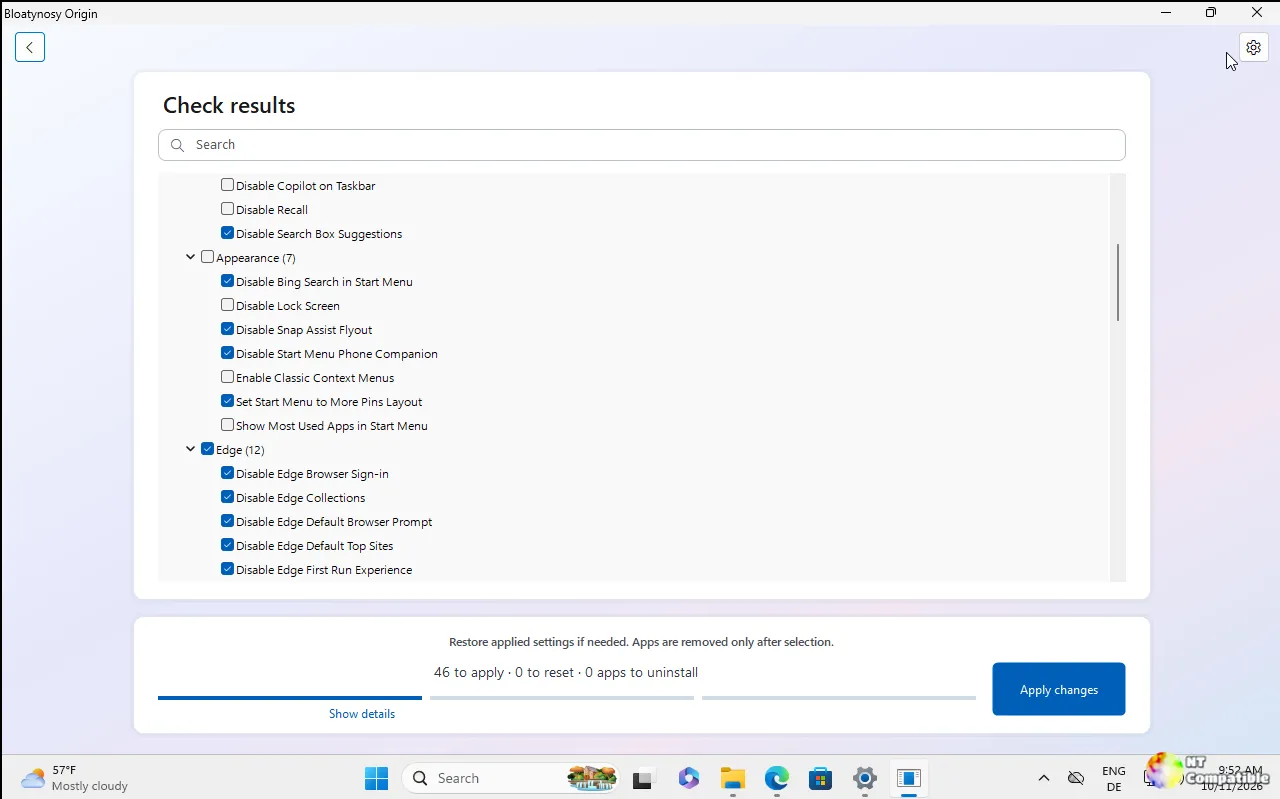
Origin takes a three-step path: check your PC, review the results, apply the changes. It changes nothing while it's only looking.
Results are grouped into a browsable tree rather than a wall of checkboxes. An "Available changes" list holds what still needs work, and an "Already applied" list holds what's already set the way the app recommends, so you can restore defaults. Select any row and a plain-language explanation shows up at the bottom; "Show details" reveals the actual registry path.
The version everyone still points to is 0.85. It was one window, a list, and a button. Later builds added tabs, a plugin store, dark mode, an AI bloatware filter, WinGet support, and a module for installing Windows 11 on unsupported hardware. Per Belim, much of the appeal faded along the way.
"Everything I built after that added more and solved less," he wrote. That subtraction is the entire pitch of Origin.
The app tries to set itself apart on trust. The README is emphatic that it doesn't patch system files, doesn't stop services, and has no mystery "Optimize" button running an unreadable script. Every change writes a single documented registry value. Each one is checked before it's written and read back after. If the readback doesn't match, the setting counts as failed and lands in the report instead of quietly claiming victory.
Everything lives in text files. The whole knowledge base is one Data/Tweaks.ini, with a section per setting. Drop another .ini into the folder and it gets read too, no DLL to compile, no manifest, no API. An existing section name replaces the original, so a plugin can correct an entry rather than just append to it.
There's an "Explain" feature that asks an AI provider for a short second opinion on the selected entry. It's off by default, wants you to bring your own API key, and supports Groq, OpenAI, Anthropic, and any OpenAI-compatible endpoint. Without it the app is completely local, and even when enabled it sends only the name and technical details of the one entry you picked. Never a scan of your whole machine.
Removed apps go through Remove-AppxPackage; packages Windows marks as non-removable, framework, or resource packages get refused. Profiles are plain JSON files you can save from the report and hand to another machine. The old code lives in a legacy/ folder that Origin shares nothing with. Requirements are modest: Windows 10 or 11, .NET Framework 4.8, and enough rights to write registry values. It runs as a standard user; machine-wide changes that need elevation are attempted anyway, and if Windows says no, the report simply names the setting.
The long way back
The history here is genuinely tangled, and it matters for why this release reads like a homecoming.
Bloatynosy launched in mid-January 2023 as Belim's first-ever release. It was renamed several times, ThisIsWin11, then Debloos, then BloatyNosy, then Bloatynosy, through what the developer calls two identity crises. In May 2023 it was briefly in the Microsoft Store before being pulled. Belim described it as being "banned by Microsoft overnight," citing a rejected update and a claim that the app "does not have a valid certificate."
The beloved peak settled on 0.85, and the last real update came in January 2025. Then about a year of silence.
What brought Belim back was oddly specific. In the Origin announcement he described seeing an employee at "a well-known company" Googling Bloatynosy and trying to download it, proof that "the legend lives on." Nobody else was going to revive the original vision, so he took the job himself.
The announcement was candid to a fault. The build had been sitting in a "ready to publish" folder for eight or nine days. He "just never got around to pressing the button." He admits it still needs an icon and some polish. "It's coming."
Belim's GitHub profile puts his self-description as simply "Working on pizza printer ..." with a pizza emoji, which says a lot about the hobbyist energy behind the thing. Solo indie, MIT-licensed utilities, PayPal links for tips.
Head here for the release and the developer's comeback thread.


